The Matching Fixture Trap: Why Every Fitting Need Not Match
Matching light fixtures can make a room feel rigid. Learn how repeating one design detail ties different fittings together without making them identical.
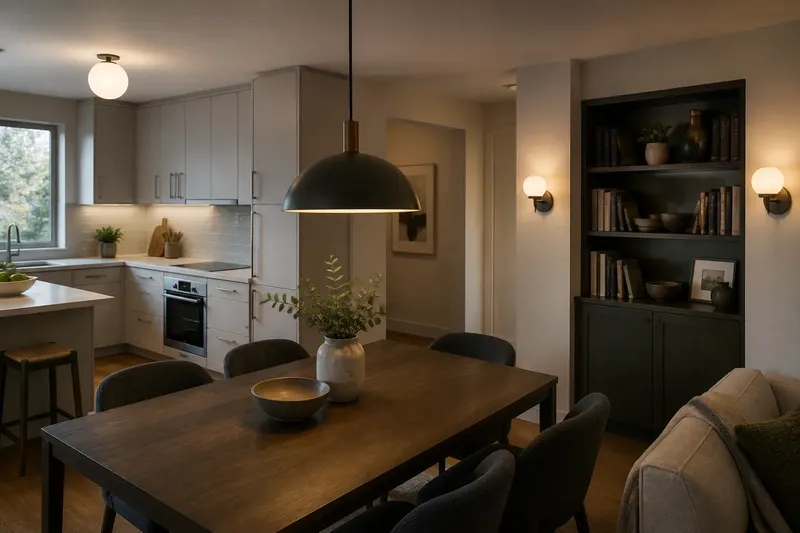
Matching light fixtures can make a room feel rigid when a dining pendant, wall lights and a ceiling fitting all compete to look like a set. A more flexible room plan repeats one clear design detail, then lets each fitting suit its own position and purpose.
Consider a made-up situation: imagine a reader furnishing an open-plan kitchen and dining room in a rented flat. The existing ceiling light is a plain white globe, while the reader needs a pendant over the table and a pair of fittings by a bookcase. Buying three identical globes seems like the safe choice, but the positions call for different shapes and light distribution. The aim is not to disguise those differences; it is to make them look deliberate.
Start with the room’s fixed features
Before choosing fixtures, the reader notes what cannot easily change: pale walls, a dark oak table, brushed-steel cabinet handles and a broad window. These details already establish a mix of finishes. A fixture scheme that adds several unrelated metals or ornate shapes could make the room feel busy, while copying one finish everywhere might look overly planned.
The reader also marks where each fitting sits in relation to furniture and sightlines. The pendant is seen against the kitchen cabinets, the bookcase lights sit close to the wall, and the ceiling globe is visible from the entrance. This matters because a fixture is both a source of light and an object in the room. A small wall fitting can carry a strong shape without dominating; a pendant has more visual weight and needs to hold its own above the table.
Choose one detail to repeat
Instead of matching whole fixtures, the reader chooses a shared detail: softly rounded shades. This is a useful visual thread because it can appear in different forms—a shallow dome on the pendant, a curved glass shade on the ceiling fitting and a rounded opal diffuser beside the bookcase. Their materials and proportions may differ, but the recurring curve links them.
A repeated detail could also be a finish, an edge treatment, a material or a restrained colour. For instance, a dark bronze accent might appear on the pendant stem and the wall lights’ backplates, while their shades remain different. Keep the shared feature easy to notice but not so dominant that every fitting appears to be a near-copy.
It helps to separate the recurring detail from the rest of each fixture. The pendant might be broad and matte, while a wall fitting is compact and translucent. If both share a curved outline, the contrast reads as variation within a family rather than a mismatch. Conversely, repeating several features at once—same metal, shape, colour and ornament—can quietly recreate the uniform set the reader was trying to avoid.
Give each fitting a distinct role in the layout
For the invented room, the pendant is selected for its position above the dining table. Its shade should direct useful light towards the surface without creating an uncomfortable view of the bulb from nearby seats. The existing globe remains in place because it provides a simple ceiling presence across the kitchen route. By the bookcase, smaller wall lights help illuminate that area without adding another large object at eye level.
This is where a room plan should guide visual decisions. A fitting that looks balanced in isolation can feel oversized above a narrow table or crowded beside shelving. Marking the fixtures on a simple floor plan, then viewing their likely outlines from the doorway and the main seats, reveals whether one shape repeats too insistently or a finish appears only as an awkward one-off.
In the imagined result, the reader keeps the white globe, chooses a dark pendant with a softly curved shade and adds compact wall lights with curved diffusers and small bronze details. The room has no identical pair, yet the curves and metal accents connect the fittings. The pendant reads as the dining area’s focal object, while the less prominent fixtures sit comfortably in their own places.
Check the combination before committing
A small selection board can prevent a costly-looking mismatch. Place finish samples, a photograph of the existing fitting and pictures of the proposed fixtures together in daylight and after dark. If the product images show different bulb colours or backgrounds, compare their silhouettes and material finishes rather than trusting the apparent brightness or colour in each image.
- Look at the fixtures from the room entrance and the main seating position.
- Check that the repeated detail is visible across the room, not only in close-up.
- Notice whether one fitting carries too much visual weight beside furniture or cabinetry.
- Compare metal finishes against handles, taps or other permanent details nearby.
- Confirm that each shade suits its location and does not obstruct the light needed there.
- Remove one proposed fixture from the group mentally; if the remaining scheme loses its only link, add a subtler shared detail elsewhere.
Do not spend effort finding an exact match for every small metal part in the room. Finishes can vary slightly between makers, and forcing perfect agreement may narrow the choices without improving the overall composition. A consistent visual relationship is usually more useful than a set that matches on a catalogue page.
How do you make different fixtures feel related?
Can different metals work in one room?
Yes. Choose one finish to recur in more than one place, then let another metal appear as a secondary note. The room feels considered when the finishes have a visible relationship to nearby fittings or furniture rather than arriving as unrelated accents.
Should all the shades have the same shape?
No. Similar curves, softened corners or repeated proportions can link shades without making them identical. Keep the overall mix calm by limiting how many strongly different silhouettes compete in the same view.
What if one fixture is already installed?
Treat it as part of the starting palette, not an obstacle. Repeat one of its colours, materials or outline details in the new fittings, while choosing their sizes and forms for their own positions.
How can you tell if the mix looks accidental?
View the room from its usual entrance and seating areas, then ask whether a shared feature is easy to spot and whether each fitting seems suited to its location. If neither relationship is clear, revise one choice rather than adding more decorative details.
Let the room guide the final balance
The matching light fixtures question is not simply whether pieces coordinate; it is whether their differences make sense in the room. A repeated curve, finish or material can provide that connection while allowing each fitting to fit its setting. In the imagined flat, the rounded shades offer continuity, and the distinct forms keep the kitchen and dining area from reading as a purchased set.
Before ordering, check the fitting’s dimensions, mounting requirements and bulb compatibility against the product instructions; ask a qualified professional where installation work calls for one. Then judge the combination at the scale of the whole room. A coherent plan leaves enough resemblance to feel intentional and enough variation for each fixture to belong where it is.