Ambient, Task and Accent Light: Three Jobs, One Room
Ambient, task and accent light give a room distinct jobs, helping you spot missing illumination and choose where a lamp or fitting will make a difference.
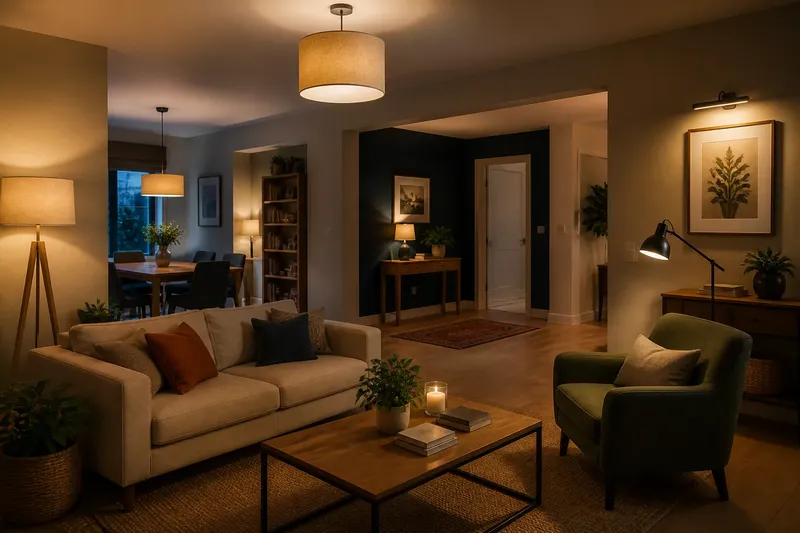
Ambient, task and accent light describe three different jobs a room’s lighting can do. If you can name the job that feels absent, it becomes easier to decide whether you need broader illumination, a focused beam or a small highlight rather than simply adding another fitting.
What does ambient light do in a room?
Ambient light provides the general illumination that lets you move around and see the room as a whole. It is the background layer: not necessarily bright or uniform, but broad enough that the space does not depend on one small pool of light.
A ceiling fitting often supplies ambient light, but it is not the only option. Several lamps with light directed towards walls or ceilings can spread illumination around a room. Pale walls may reflect more light into the space, while dark or heavily textured surfaces can absorb it, so the same bulb and fitting may feel different in different rooms.
Think of ambient light as the room’s visual base. If the far end of a lounge disappears into shadow while the ceiling fitting makes the centre feel harsh, the issue may be distribution rather than a lack of total brightness. Light reaching walls and corners can make the room easier to read without turning every surface equally bright.
What counts as task lighting?
Task lighting helps you see clearly while doing a particular activity. Reading, preparing food, writing, sewing and applying make-up all involve looking closely at a surface or object, so they need light directed where the activity happens.
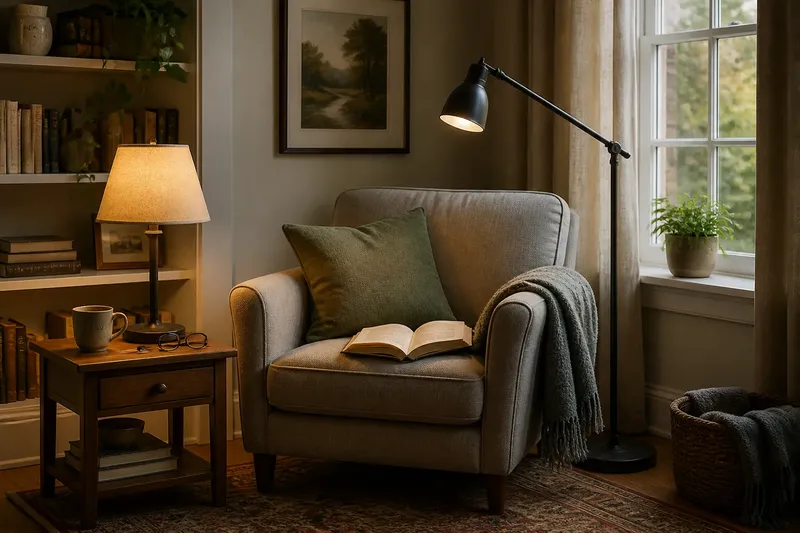
The right position depends on the task. A desk lamp should illuminate the working area without putting a bright reflection on a screen. At a kitchen worktop, light should reach the surface rather than the cook’s back. For reading, the page needs enough light to see comfortably, while the lamp itself should not dominate your view.
Task lighting is not defined by the style of the fitting. A pendant can illuminate a table for a board game, and a small lamp can support paperwork. What matters is whether the light reaches the relevant area and remains comfortable as you move or change position.
How is accent lighting different?
Accent lighting draws attention to a chosen feature. It might pick out a painting, a textured wall, a plant or an architectural detail. Rather than making the whole room easier to use, it gives a particular object or surface more visual prominence.
A narrow-beam spotlight, a picture light or a small lamp aimed at a decorative object can create an accent. The effect depends on contrast: if the surrounding area is already very bright, the feature may not stand out. Conversely, a strong beam in an otherwise dim room can feel abrupt, so the accent should relate to the room’s general light.
Accent lighting is optional in many rooms. It can add depth and help direct the eye, but it should not be mistaken for useful light over a desk or safe, clear illumination for moving around. If a room already feels busy, adding another highlighted object may make it harder to know where to look.
How can you tell which lighting job is missing?
Notice what feels awkward before choosing a fitting. If you cannot see the room comfortably as you cross it, consider ambient light. If a specific activity leaves you squinting or casting a shadow over your work, look at task lighting. If everything is usable but a feature looks flat or disappears, accent lighting may help.
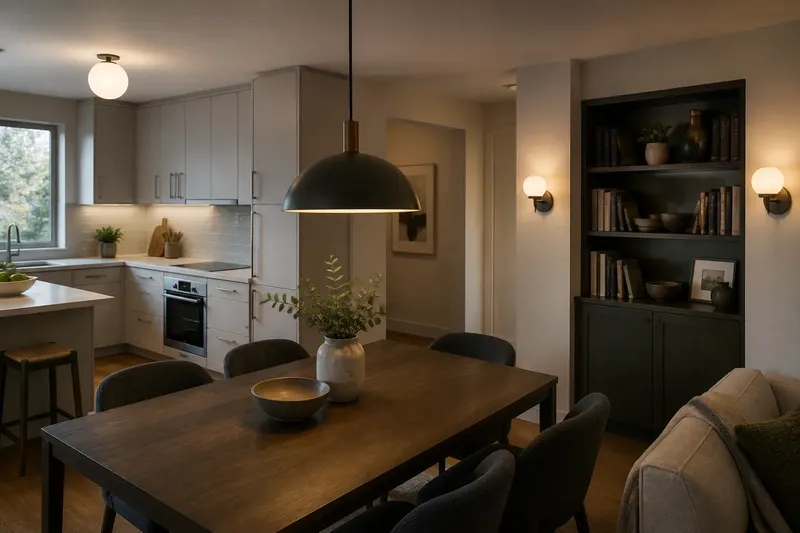
Say you have a dining room with a pendant over the table, a dark passage to the doorway and a framed print that vanishes after dusk. The pendant may already provide task light for eating or games; a lamp or other suitable source that spreads light towards the passage could address the ambient gap, while a modest picture light could serve as an accent. Each addition has a separate purpose, so you can decide whether both are useful instead of treating every dim patch alike.
Try to describe the problem in observable terms: “I cannot see the chopping board clearly” is more useful than “the kitchen needs better lighting”. The first points towards task light at the worktop; the second could lead to an unfocused purchase that leaves the actual difficulty unchanged.
Can one fitting serve more than one job?
Yes. A fitting can contribute to more than one lighting layer, especially if its direction or output can be adjusted. A floor-standing uplighter may add to the room’s ambient light, while an attached reading arm provides task light. A pendant can illuminate a table and also contribute to the overall room light.
It helps to judge each job separately, even when one object performs both. Ask whether the fitting lights the activity comfortably and whether the room still feels legible away from that activity. A table lamp that is excellent for reading may leave the rest of a large room dim; that does not make it a bad lamp, but it may not solve the ambient need.
Controls can make a shared fitting more adaptable. Separate switches, dimming or adjustable heads let you use one purpose without always using another. Check that the bulb, fitting and control are compatible, and follow the product instructions for any installation or adjustment that involves electrical work.
What should you consider before adding another light?
Start with the place and time the room is used. A kitchen used for food preparation needs dependable light at the work surfaces; a sitting room used for conversation may need a softer spread that includes faces and walls. The same room can have different needs at different times, so a single source may not suit every activity.
- Identify the activity. Name what you do in the dim area, such as reading, sorting laundry or serving food.
- Locate the light gap. Check whether the problem is across the room, on a working surface or on a feature you want to notice.
- Check the direction. Look for shadows from your body, glare in a screen or light aimed away from the useful surface.
- Consider the surroundings. Reflective surfaces can create glare, while darker finishes may make a room feel less evenly lit.
- Choose the job first. Decide whether a candidate fitting should provide ambient, task or accent light before choosing its appearance.
- Review the controls. Consider whether the light needs a separate switch or adjustable output to suit the room’s different uses.
It is not worth chasing perfect brightness in every corner or highlighting every decorative object. A room needs enough light for its actual uses, not a separate fitting for every surface. Too many competing sources can create glare and visual clutter while making the controls harder to manage.
Which lighting job should you address first?
Is ambient light the same as overhead light?
No. Overhead fittings are a common source of ambient light, but lamps that spread light around the room can also contribute. The distinction is the job the light does, not where the fitting sits.
Does accent lighting help with reading?
Usually not on its own, because accent light is aimed at a feature rather than a reading area. A reading light should put comfortable illumination on the page without creating distracting glare.
Can a room have task light without ambient light?
It can, but a very concentrated pool of light may leave the surrounding room difficult to see. If the room feels disjointed, adding broader illumination may help the task light sit within a more readable space.
Should every room have all three types?
No. The useful mix depends on the room’s size, surfaces and activities. A room used for one simple purpose may need little accent lighting, while a shared room may benefit from several distinct jobs.
How does naming the job improve a lighting choice?
It turns a vague impression into a decision you can check. “The corner is dark” could mean that the room lacks ambient spread, that a chair needs a reading light or that a feature needs an accent. Naming the intended job helps you compare possible positions and fittings without assuming that adding light anywhere will help.
When choosing ambient, task and accent light, treat the categories as a way to observe the room, not a rule that every fitting must fit neatly into one box. A useful arrangement is one in which people can move, see their chosen activities and notice the features that matter, with each source earning its place through a clear purpose.