Table Lamp or Floor Lamp for a Reading Corner?
Compare a table lamp or floor lamp for a reading corner by footprint, shade position and seating fit, then choose a light that suits your layout.
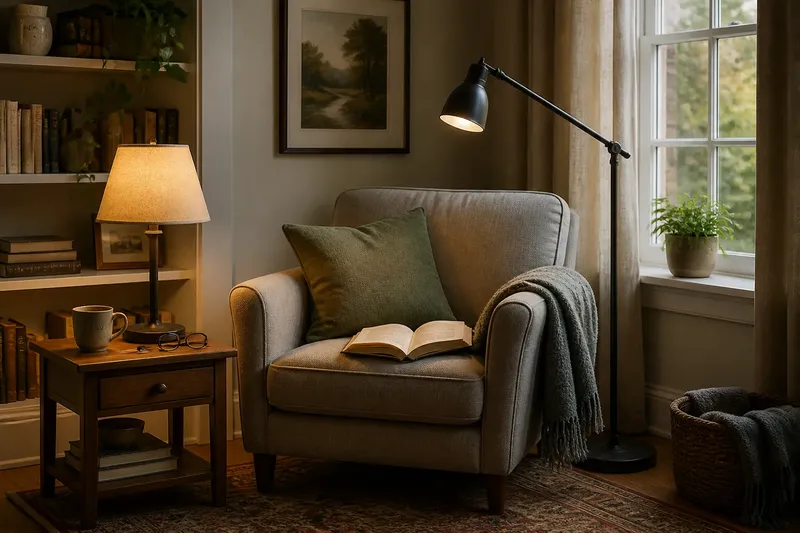
A table lamp or floor lamp for a reading corner should be chosen around the seat, not simply the empty patch of floor beside it. The useful question is where the shade can sit in relation to your book, your eyes and the furniture already in place.
Start with the seat and the available footprint
A table lamp needs a stable surface: a side table, a broad armrest designed to take objects, or a shelf within comfortable reach. The lamp’s base shares that surface with a drink, glasses or the book you are reading, so a narrow table may feel crowded even if the lamp technically fits.
A floor lamp uses floor space instead, but its base still needs a place where feet, chair legs and the route through the room will not catch it. A tripod base can spread across more floor than its stem suggests; a weighted disc base may occupy less visible space but can still obstruct a low footstool.
- Check whether the chair can move in and out without striking the lamp or its base.
- Look at the table top while it is in ordinary use, not only when cleared for the lamp.
- Notice the path from the doorway to the seat, especially if the corner is part of a narrow passage.
- Consider whether a recliner, rocking chair or swivel seat changes position as you settle in.
When floor space is tight, a table lamp can be the tidier choice if a suitable surface is already beside the chair. When the table is small or already busy, a floor lamp may preserve its working surface, provided the base can sit outside the chair’s movement.
Place the shade for the page, not just the room
The shade’s position matters more than the lamp’s category. For reading, the light should reach the open book without making the bulb itself an uncomfortable bright point in your view. A shade that sits too low can leave the page dim; one that is too high or aimed away may light the wall more than the text.
A table lamp often places its shade near the seated reader, but the result depends on the height of the table, the chair and the lamp. A low side table paired with a tall lamp may bring the shade into a useful position; a high table and a short lamp can leave the light below the page.
A floor lamp can place its shade above or beside the reader, depending on its design. An adjustable arm makes it easier to direct light towards a book, while a fixed uplighter may brighten the surrounding area but offer less control over the page. A floor lamp with a reading arm combines a tall stem with a smaller directed shade, though the extra arm needs room to swing without hitting a wall or shelf.
Before choosing, sit in the chair and note where the book naturally rests. If you read with it in your lap, the shade needs a different position than if you hold it close to your chest or place it on a book stand. An adjustable shade can help accommodate more than one posture, but it cannot compensate for a base that has nowhere sensible to stand.
Match the lamp to the furniture already there
A table lamp is a natural fit beside an armchair with a side table, but the table need not be a matching furniture set. A compact cabinet, sturdy nesting table or wall-mounted shelf may provide a surface if it remains accessible from the seat. Check that the lamp base sits fully on the surface and that reaching for the switch does not require an awkward lean.
A floor lamp suits a corner where there is no useful table, or where the existing table is better kept clear. It can sit behind the chair’s shoulder, beside an arm or just beyond the front edge, depending on the base and shade. Keep the stem and shade clear of curtains, tall plants and shelves that could block the light or restrict adjustment.
Imagine a reading chair beside a narrow side table already holding a cup and spectacles. If there is a clear patch behind the chair and outside its recline, a floor lamp with a compact base and a directed shade could keep the table free while lighting the book. If that patch is part of the route to the doorway, a small table lamp may be the more considerate fit, even if it means moving one item from the table.
Which lamp fits your reading corner?
Is a table lamp better for a small reading corner?
It can be, when a stable side table is already in place and the lamp does not crowd the items you use. If the only available surface is too narrow or awkward to reach, a table lamp may make the corner feel more cramped rather than more compact.
Is a floor lamp better beside a recliner?
A floor lamp can work well when its base sits beyond the recliner’s moving parts and its shade remains in position as the chair adjusts. Check the full range of the footrest and backrest before settling on a spot.
How high should a reading lamp shade be?
There is no single height that suits every chair and reading posture. Sit in your usual position and check that the light reaches the page while the bright bulb remains screened from your direct view.
Can a floor lamp go behind a reading chair?
It can, if the shade can direct light towards the book and the chair does not block it. A lamp directly behind the reader may cast a shadow from the head or shoulders, so test the position while holding a book as you normally would.
Look at control, reach and everyday use
A lamp that is easy to switch off from the chair is more convenient than one that requires a stretch or a trip around the furniture. Table-lamp switches may sit on the base, stem or cord; floor-lamp switches may be on the stem, cord or a foot control. The switch location is a small detail to check before buying, particularly if you read while seated and prefer not to lean down.
Think about the lead as part of the placement. A floor lamp may need a longer route to a socket, while a table lamp can still leave a cord crossing a walkway. Keep cords out of footpaths and away from moving chair parts; avoid hiding a lead where it could be pulled, pinched or damaged.
Some lamps use a replaceable bulb, while others have an integrated light source. With a replaceable bulb, check the fitting, permitted bulb type and shade clearance against the manufacturer’s instructions. Dimmable controls also need to be compatible with the lamp and bulb; a control that is not designed for the combination can produce unreliable operation.
Choose a design that suits the corner’s scale
A tall, narrow floor lamp can make a corner feel less crowded than a broad shade and sprawling base, but a very thin stem may look out of place beside a large chair. Conversely, a table lamp with a wide shade can dominate a small side table even when its base is modest. Judge the whole silhouette from the doorway and from the seat.
Shade material and shape affect where light goes. A shade that is open at the bottom can direct light towards a page and tabletop, while a more enclosed shade may soften the bulb’s glare but limit the downward beam. Opaque and translucent materials also distribute light differently. Treat these as practical choices, not rules: the bulb, shade lining and room surfaces all influence the result.
It is not worth choosing a lamp solely because its stem or base matches another fitting in the room. For this corner, the more useful comparison is whether its shade can reach the page and whether its footprint fits around the chair without creating an obstacle.
Make the decision in the actual corner
Before shopping, mark the likely base or table footprint with a folded newspaper or a piece of card. Sit down, move the chair as you normally do and check whether the marked area remains clear. This simple mock-up helps reveal conflicts that are easy to miss when considering a lamp in isolation.
Then hold a book in your usual reading position and identify where the shade would need to be. If you already own a movable lamp, place it temporarily near the chair and observe where its light falls; do not treat that as a measurement of what every lamp will do, since shade shape and height differ. The purpose is to understand the direction and reach that feel comfortable.
The main search phrase, table lamp or floor lamp for a reading corner, comes down to three checks: available footprint, shade position and fit with the seating you already use. Choose the table lamp when a stable, reachable surface makes the light easy to place; choose the floor lamp when its base can stay clear and its shade can reach the page. If neither position works without blocking movement or forcing an awkward posture, reconsider the furniture arrangement before buying.